






























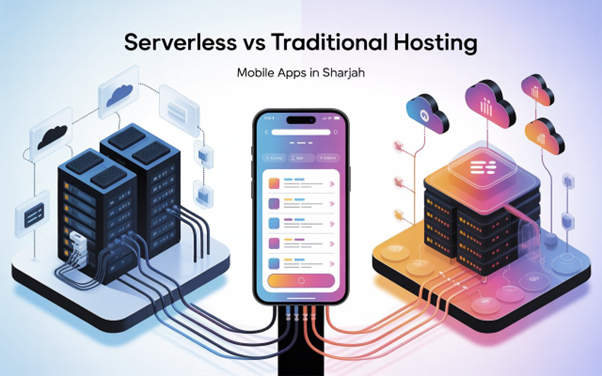
Entering the modern digital environment, businesses in Sharjah are gradually depending on mobile applications to reach consumers, facilitate sales, and increase their revenues. The type of hosting environment that you select to host your mobile application can greatly impact the performance of the mobile app, its scalability, as well as the cost of its maintenance. This brings us to a critical discussion in the tech world: Serverless vs Traditional Hosting.
Although classic hosting has been in use since time immemorial, serverless infrastructure is gaining momentum, with zero flexibility and affordability to adopt by contemporary mobile applications development in Sharjah.
The advantages and disadvantages of these forms of hosting must be known to companies that would like to remain competitive in Sharjah. Mobile applications may experience unpredictable traffic, multi-faceted back-end demands, and unpredictable uptime expectations.
This is because an informed choice between traditional hosting and serverless hosting will make businesses capable of providing a smooth user experience, minimizing downtime, and effectively managing operational expenses. This guide discusses the two hosting models so that you can be able to determine which model fits best to your needs with your mobile app.
Serverless vs Traditional Hosting: Which One is Better for App Development?
Serverless and traditional hosting can have the same end goal of ensuring the availability of your app on the internet. Their resource management, however, shows a great difference. Traditional hosting entails the addition of dedicated or shared servers, configuration management, and manual scaling with increased traffic. This would provide more control to the developers but would demand ongoing maintenance and initial investment.
Serverless hosting, on the contrary, makes server management abstract. Resource allocation is automatic, which means that the resources are allocated to the user demand and thus developers just pay according to the time the app is being actively run. The model is very scalable and efficient, and is, therefore, especially interesting to startups or any business anticipating the variations in the traffic patterns. For a mobile app development company in Sharjah, choosing between these two depends on the app’s complexity, budget, and long-term maintenance goals.
What Do Serverless Hostings Provide in Application Development?
Serverless hosting has a number of mobile app development benefits:
- Scalability on Demand: Serverless provides the concept of scaling automatically with the traffic. E-commerce or event booking apps are good examples of apps that have sudden spikes and can still be responsive without human intervention.
- Cost Effectiveness: Developers are only charged for the real usage of resources. This pay-as-you-go is best suited to the business whose patterns of traffic are unpredictable, and the operational costs would be minimized.
- Less Maintenance: No friendliness to support servers, deploy patches, and maintain uptime manually. The cloud supplier takes care of the infrastructure, thus leaving application developers with advanced app functionality to work on.
- Shorter Time-to-Market: Serverless architecture enables faster deployment of applications because the developer does not need to manage the framework of backend infrastructure, but can write business logic.
- Improved Reliability: With a good number of serverless, there is compatibility of automatic failover and redundancy to ensure the apps to run remain operational regardless of the occurrence of problems in a single server or region.
For companies looking to hire app developers in Sharjah, these benefits make serverless hosting a compelling choice, particularly for startups and SMEs aiming to launch innovative apps without heavy upfront investment.
What are the Advantages of Using Traditional Hosting to develop an app?
Conventional hosting has its own unique benefits, particularly to businesses with certain control and compliance needs:
- Full Control of Servers: Developers have the ability to tune servers to their specific needs, to optimise performance in applications with specialised backend needs, or with high database access.
- Fixed Costs: When using dedicated or VPS hosting, the costs are fixed each month, and this assistance may make it easier to budget consumption of greater businesses.
- Flexibility Customization: When using traditional hosting, one can install custom software, security, and server-side frameworks that are not always aided by serverless platforms.
- Data Compliance: There are certain industries in which strict data residency or security is demanded. Conventional hosting has the ability to offer increased control over data storage and usage.
- Consistent Performance: Serverless infrastructure has uncertainties of scaling, whereas traditional hosting can provide revelation in state performance due to an app with consistent traffic and resource usage.
Serverless is the best fit in dynamic workloads, but traditional hosting is a reliable option in an organization that needs specialist settings or compliance-related deployment.
What is the best way to find a mobile app developer who will provide you with the most favorable app development?
The essential consideration in taking advantage of the benefits of either hosting model is proper recruitment of the mobile app developer. This is the way to make sure that businesses in Sharjah receive the best talent:
- Portfolio Analysis: Examine the previous work of the developer to make sure he/she have worked with serverless or conventional hosting setups.
- Technical Skills: seek out experience in programming languages that your app will use, back-end frameworks, and cloud solutions.
- Problem-Solving Skills: A developer is supposed to forecast possible scalability challenges and, depending on them, streamline the app structure.
- Communication and Collaboration: Collaboration with your team simplifies meeting of project timelines as well as understanding the requirements.
- Never-ending Learning: The process of mobile app development is growing rapidly. The developers who keep abreast of fashion, like serverless architecture and cloud-native development, add value to your project.
Partnering with a mobile app development company in Sharjah can simplify this process, as they already maintain a skilled team capable of handling both hosting models.
Conclusion
There’s no magic answer when picking between serverless and regular hosting. Serverless is good if you need your app to scale automatically, save on costs, and require less upkeep. Regular hosting gives you more control, predictable performance, and certain compliance benefits. Make sure you choose based on what your app really needs, how much traffic you expect, and what you can afford.
Finally, the appropriate hosting environment and talented app creators lead to improved experiences of users, service performance, and business development. Regardless of either serverless or non-serverless, or a combination of both, Sharjah-based businesses could succeed in digital transformation by making a sound choice and collaborating with a reputable company such as TechGropse.